The problem with land speculation
For centuries, we've treated land as a speculative asset instead of a finite resource — engineering an affordability crisis. Land value return is the fix.

Problem
“Roads are made, streets are made, railway services are improved, electric light turns night into day, electric trams glide swiftly to and fro, water is brought from reservoirs a hundred miles off in the mountains — and all the while the landlord sits still… To not one of those improvements does the land monopolist as a land monopolist contribute, and yet by every one of them the value of his land is sensibly enhanced.”— Winston Churchill
For decades, the United States has treated land not as a finite natural resource essential for life, but as a speculative financial asset. Across the country—from booming metropolises to rural communities—the unearned value of land has detached completely from the real economy. By allowing private interests to monopolize location values created by public investment and community growth, we have engineered an affordability crisis that stifles economic dynamism.
This structure is pre-programmed to drive inequality. When land acts as a vehicle for speculation rather than a site for living or working, it extracts wealth from productive laborers and businesses and funnels it to passive landowners. This creates a parasitic drag on our economy, where rising rents devour wages, innovation, and capital investment.
Land speculation:
▸Raises housing prices for American workers
- •Land prices have skyrocketed relative to wages. Land values in major U.S. metros have appreciated faster than the cost of construction and median household incomes.
- •Speculation restricts supply. By holding prime locations vacant or under-utilized to wait for future appreciation, speculators artificially constrain the supply of available housing, driving up costs for everyone else.
▸Blocks access to homeownership
- •Investors outbid families. Institutional investors and private equity firms, leveraging cheap capital, are purchasing single-family starter homes in bulk. In Q2 2024 alone, investors bought one in six homes sold in the U.S., rates at record highs (Redfin, 2024).
- •Down payments are insurmountable. Because land value appreciation outpaces savings rates, the barrier to entry for first-time buyers grows steeper every year, locking millions out of the primary vehicle for American wealth creation.
▸Traps families in a cycle of renting
- •The "Build-to-Rent" pivot. Major homebuilders are increasingly abandoning the model of selling homes to families. Instead, they speculate on suburban land tracts, wait for public infrastructure to increase the value, and build entire communities exclusively for rent.
- •Monetizing trapped demand. By controlling the land supply in high-growth areas, these corporations bet on "induced demand"—knowing that families need to live near jobs and schools—to drive up rents across their diversified portfolios.
▸Creates generational racial and wealth inequality
- •The legacy of exclusion. Because land ownership is the primary driver of intergenerational wealth, centuries of redlining and exclusion have left Black and Brown communities with a fraction of the land wealth of White families.
- •Disparate impact. Housing market appreciation has explained 70% of the increase in the median White-Black wealth gap over the past several decades.
- •Speculation targets minority neighborhoods. As land values rise in gentrifying areas, long-time minority residents are often displaced by rising property taxes or rents.
▸Heightens carbon emissions and sprawl
- •Leapfrog development. Because it is cheap to hold valuable urban lots vacant (due to low taxes on land), developers are pushed to build on the cheaper periphery of cities. This "sprawl" destroys farmland and natural habitats.
- •Increased reliance on cars. This artificial spread of development forces workers to commute longer distances, significantly increasing vehicle miles traveled (VMT) and carbon emissions. Transportation is now the leading source of greenhouse gas emissions in the U.S. (EPA, 2025).
Solution: Land Value Return
“As soon as the land of any country has all become private property, the landlords, like all other men, love to reap where they never sowed, and demand a rent even for its natural produce.”— Adam Smith
For too long, we have allowed the value created by our communities to be privatized by a few, while the costs of maintaining those communities are socialized onto the many. Securing economic justice in America means addressing the root monopoly that underpins all others: the monopoly of land.
The way forward is Land Value Return: a commitment to capturing the value of nature and community growth for the public good, rather than letting it accrue to passive speculators. By returning land values to the community that created them, we can lower taxes on labor and production, making housing affordable and the economy dynamic.
Option 1
Lease the Land
Governments can retain ownership of land and lease it to private actors for long terms (e.g., 99 years). This allows the public to capture the rising value of the location (ground rent) while private individuals own and profit from the buildings and businesses they create.
Option 2
Tax the Land
For privately held land, we can shift the tax burden off of productive labor and capital and onto the value of the land itself. While land leasing is a powerful tool for new developments, the most pragmatic path for the majority of American cities is reforming property taxes.
The Policy: Shift Taxes to Land
Our current property tax system is broken. It punishes development and rewards stagnation. Every time a homeowner renovates their kitchen, or a business expands its factory, their property taxes go up. We literally fine people for improving their communities.
Meanwhile, a land speculator who buys a vacant lot in the city center and leaves it empty—contributing nothing while waiting for the neighborhood to improve around him—pays a pittance.
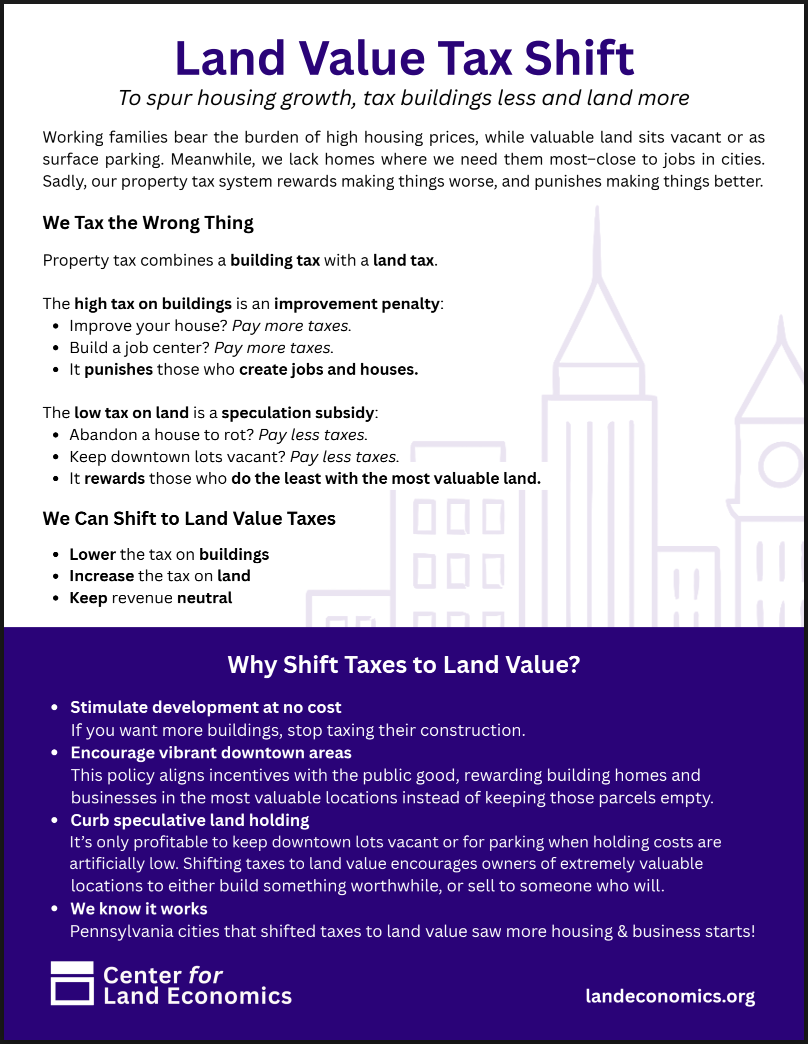
The solution is shifting taxes to land value. While keeping total revenue neutral, municipalities can implement property tax policies which result in a shift. This includes a split-rate tax, where the city implements a lower rate on improvements (buildings, renovations) and a higher rate on land value.
- For the homeowner and builder: The penalty for improving a property disappears. Build a new apartment complex or fix your roof, and your taxes barely move because the land value beneath you hasn't changed.
- For the speculator: The cost of holding valuable land idle rises. Vacant lots and boarded-up buildings become expensive liabilities rather than patient assets. The only rational response is to develop the land or sell it to someone who will.
States Across the Country are Considering Land Value Tax Legislation
We maintain a dedicated Land Value Tax legislation tracker with interactive state-by-state coverage, policy notes, and source links.
View the Land Value Tax Legislation Tracker