
Taxing Land,
Not Homes
A Revenue-Neutral Path to Unlock Spokane's Underused Land
Overview
A revenue-neutral path to unlock Spokane’s underused land
Housing affordability, economic vitality, and productive use of urban land are among the defining challenges facing Washington’s cities. Unfortunately, the state’s property tax system perpetuates all three, quietly rewarding landowners who hold valuable properties vacant while penalizing those who build. A revenue-neutral shift in the property tax structure would give Washington cities a new tool to fix these incentives while preserving existing taxpayer protections and revenue constraints.
One way to achieve this is to shift property taxes off buildings and onto land in a revenue-neutral way: cities exempt a portion of building value from taxation, then raise the overall tax rate, collecting the same total revenue as before. This meaningfully shifts who bears the burden — landowners who leave valuable land vacant or underused would pay more, while homeowners and developers who invest in buildings would pay less.
In Spokane, nearly $1 billion in land value sits vacant or significantly underdeveloped across the city, much of it concentrated downtown and in other high-demand locations where housing and economic activity are needed most. This report models how one version of this approach would work in Spokane. For the levies affected by the building exemption, the model finds the following changes relative to the current system:
- The median single-family home sees around a 4 percent tax decrease, and the median small multifamily property sees a 10 percent decrease.
- Vacant land and surface parking lots see median tax increases exceeding 110 percent, raising holding costs on speculative or low-intensity uses.
- The reform is progressive: lower-income neighborhoods experience larger median tax reductions than higher-income neighborhoods.
Pennsylvania cities that adopted similar land-focused reforms lend credence to shifting taxes to land: they saw increased housing production, stronger infill development, and measurable growth in business activity.
Spokane has already done much of the hard work of expanding housing capacity and modernizing its land use rules. A land-focused property tax shift would add a complementary tool that works through the tax code rather than the zoning code, turning up the heat on speculation by making it more costly to sit on vacant and underutilized land while public and private investment nearby pushes up value.
The modeling in this report suggests such a shift in Spokane would reduce penalties on housing and productive development, leave most single-family homeowners unaffected, and produce progressive outcomes across both income and race — all while maintaining revenue stability and full legal compliance.
The problem
Spokane’s underdeveloped land
Spokane has taken meaningful steps in recent years to encourage infill development, including broad upzoning, expanded housing capacity, and targeted planning reforms. These changes have improved what is legal to build across much of the city. Yet despite this progress, much valuable land remains vacant or underused, even in locations where demand for housing and economic activity is strongest.
Land derives its value from the opportunities it offers for productive use. High land values signal access to jobs, amenities, infrastructure, desirable neighborhoods, and markets. When land in these high-value locations remains empty or lightly used, it is not because demand is absent, but because something is preventing private investment from responding to that demand.
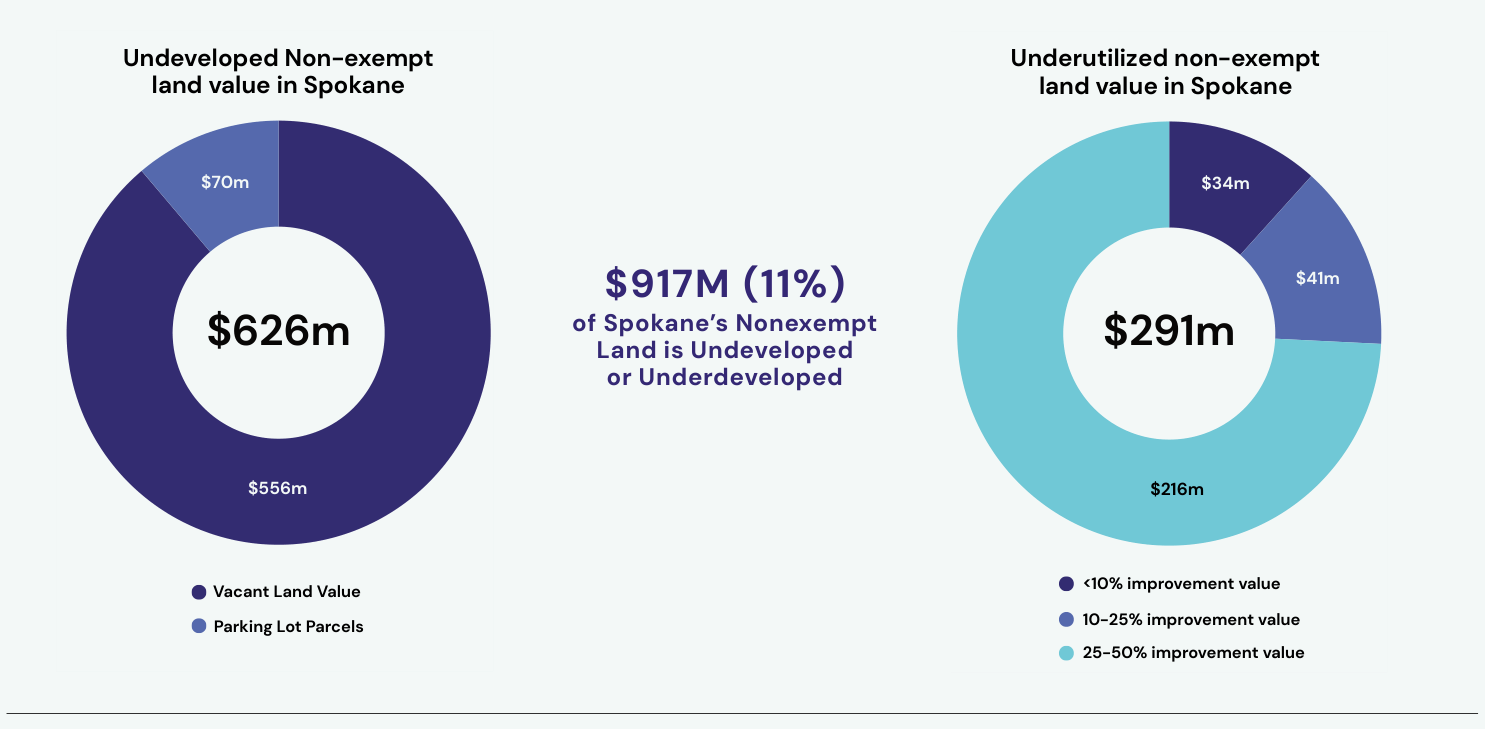
In Spokane, the mismatch between land values and buildings is substantial. Across the city, $626 million of non-exempt land value is tied up in undeveloped parcels, composed of $556 million in vacant land and $70 million in surface parking lots. These figures concern only parcels that are entirely undeveloped and do not account for partially developed sites, such as office buildings or retail centers surrounded by large parking surfaces.
Beyond fully vacant land, Spokane also contains a significant share of underutilized parcels where the value of the land far exceeds the value of what has been built on it. Parcels with very low improvement-to-land value ratios account for an additional $291 million in non-exempt land value. Taken together, nearly $1 billion of Spokane’s land value, more than 10 percent of the city’s non-exempt land base, is either undeveloped or developed well below its economic potential.
In a healthy, well-functioning land market, we always expect to see some land in an undeveloped state. However, we would naturally expect that vacant land to be either marginal, unbuildable, concentrated on the outskirts of town, or temporary. However, when vacant land climbs to 10 percent, and many of those parcels are concentrated in the most valuable and well-resourced central locations, something has gone badly wrong.
Nearly a billion dollars of non-exempt land value in Spokane is un- or under-utilized

Source: CLE analysis of assessor data
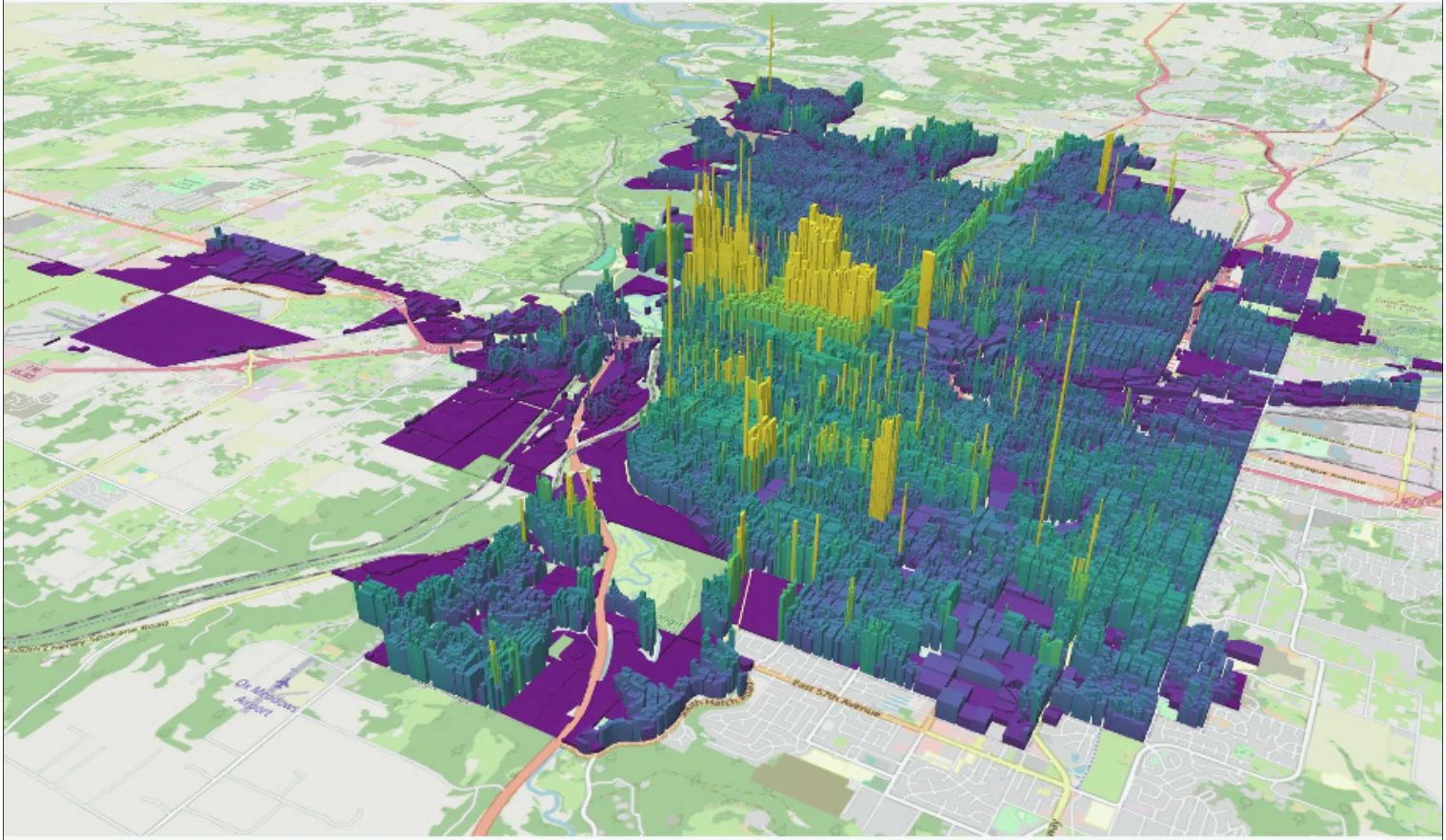
There is no easier way to quickly visualize a city’s potential than to put land value on a map. Instead of buildings, we display the economic value of each parcel by vertically extruding it proportional to its land value per unit area. Since land value grows where demand, access, and economic opportunity are most concentrated, the resulting landscape charts where the city’s economic gravity is strongest.
The pattern is unmistakable: downtown Spokane and other high-demand areas rise sharply, indicating some of the most valuable locations in the city — and the region.
Spokane's highest land values are concentrated downtown and in other high-demand locations
Parcel heights represent land value per unit of land area, showing where access, amenities, infrastructure, and market demand are most concentrated.
Source: CLE analysis of Spokane parcel assessment data.
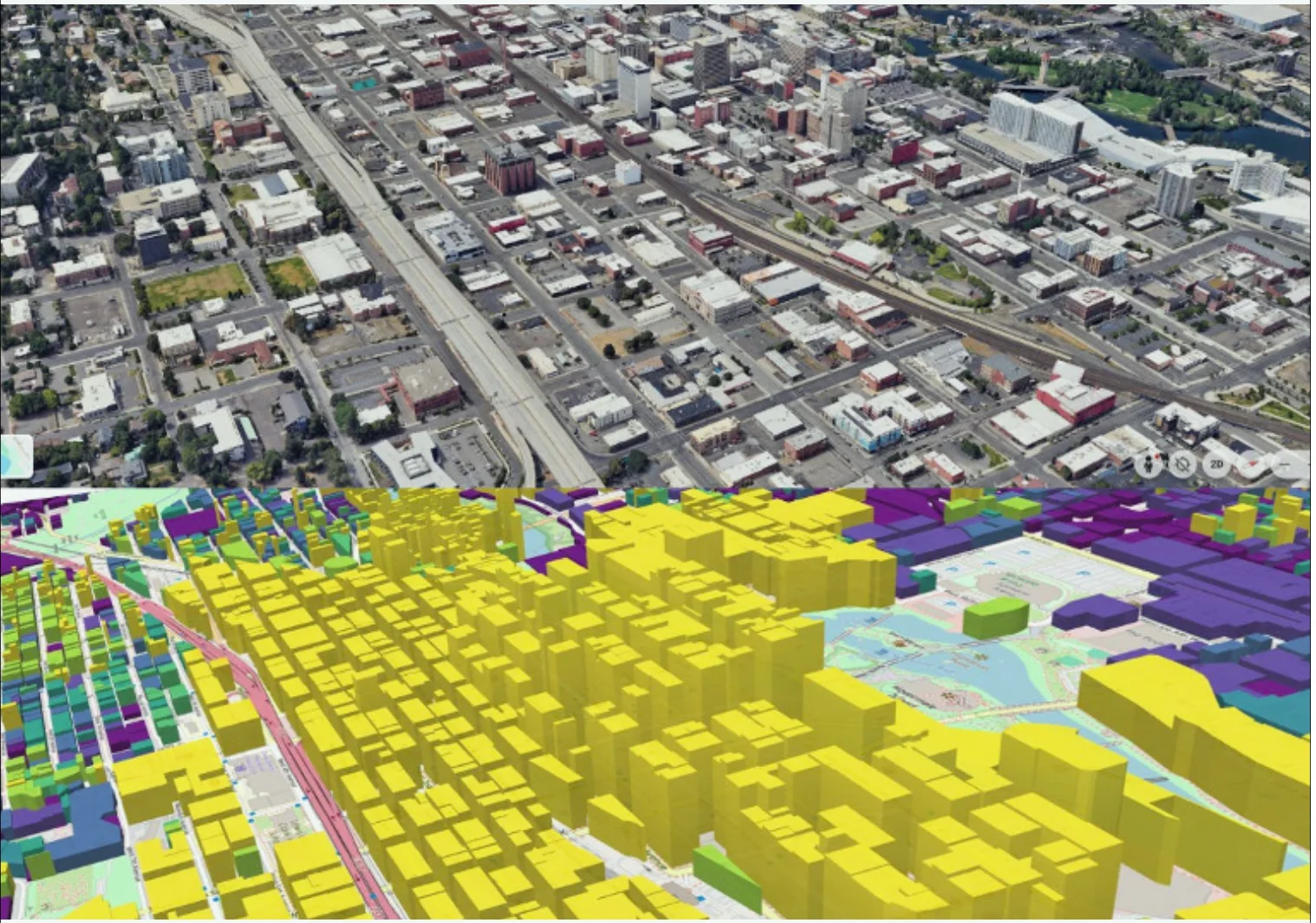
We can contrast this view of economic potential with a view of economic reality by constructing a second map of the same locations using satellite imagery. Instead of the dense, productive community uses that typically accompany high urban land values, we see countless surface parking lots, vacant land, and other low-intensity uses. This contrast highlights an all-too-common mismatch between what land is worth and how it is used, suggesting that an outsized share of Spokane’s most valuable land is often held for speculation.
Valuable urban land is often used for surface parking, vacant lots, and other low-intensity uses
Comparing land value intensity with satellite imagery reveals a mismatch between Spokane's most valuable locations and their current built form.
Source: CLE analysis of Spokane parcel assessment data and Google Earth.
In a healthy urban environment, development intensity tracks land value; taller or denser buildings appear where land is most valuable. This intensity tapers off as values decline further from the city center. In Spokane, the contrast between land value and the built environment highlights a persistent disconnect. Highly valued parcels remain idle or underbuilt, not because they lack demand, but because incentives built into the tax system make it more favorable to hold land than to improve it.
How Washington’s property tax system works — and why it discourages development
To understand why shifting tax burden from building to land matters, we must first understand how Washington's property tax system works.
The basics: two taxes in one bill
In Washington state, property taxes are levied on two distinct things: the land a property sits on, and any improvements on that land (meaning buildings, structures, or anything else that has been built there). Every year, county assessors estimate the market value of both components separately. Those two values are added together to produce a property’s total assessed value, and the property tax bill is calculated from that combined number.
This means that when a property owner builds a new home, adds an apartment unit, or renovates a commercial building, the assessed value of their improvements rises, and so does their tax bill. Meanwhile, the value of the land beneath the building is taxed the same. However, the moment an owner invests in putting that land to productive use, the tax system responds by charging them more.
The 1% caps: why cities can’t simply raise more revenue
Washington’s property tax system operates under two important legal constraints that shape what cities can and cannot do.
The first is the constitutional levy rate cap, commonly called the 1% rule. This limits the total regular property tax rate that can be applied to any property to no more than 1 percent of its assessed value, or $10 per $1,000 of value, when all overlapping taxing districts are combined. In practice, most properties in Washington are already at or near this ceiling when you add up state, county, city, school, and other district levies. This means cities generally cannot simply raise their levy rate to generate more revenue; the legal ceiling is already close.
The second constraint is the 1% annual increase cap on levy collections. Even if a city stays within the rate ceiling, it cannot increase the total amount of property tax it collects by more than 1 percent per year, regardless of how much property values have risen. This is a significant limitation. In a city like Spokane where land values have grown substantially, the tax base is growing faster than the revenue cities are allowed to collect from it. Cities are effectively leaving money on the table, not by choice, but by law.
Together, these two caps mean that Washington cities are operating under genuine fiscal constraints. They cannot easily raise more revenue from property taxes. This is precisely why the revenue-neutral design of this approach is so important: it is not asking cities to collect more, only to collect differently.
Why the current system rewards vacancy and punishes investment
Status quo dynamics create incentives that work against what most cities want: more housing, more economic activity, and more productive use of valuable urban land.
Consider what the current system signals to a landowner. If they hold a vacant lot in a desirable part of the city, they pay taxes only on the land value, which, because of the caps described above, is often modest relative to what the land is actually worth on the open market. If they build housing or a commercial building on that same lot, their assessed value rises, their tax bill rises, and they take on all the costs and risks of development. The tax system does not reward them for putting land to productive use. It penalizes them for it.
Meanwhile, a landowner who does nothing, who simply holds land and waits for its value to rise, faces no such penalty. They pay a relatively low tax bill year after year while the surrounding community’s investments in infrastructure, amenities, and economic development push their land value higher. The community creates the value; the landowner captures it, largely untaxed.
This is not a flaw that individual property owners or developers can be blamed for exploiting. It is a structural feature of the tax system, and rational actors respond to it rationally. The result, as the following examples illustrate, is a city where some of its most valuable land sits vacant or underused not because demand is absent, but because the tax system makes waiting more financially attractive than building.
The incentive problem in practice
The gap between what land is worth and what owners pay to hold it idle shows up clearly when we compare neighboring properties in downtown Spokane.
Example 01
Downtown office buildings pay several times more per square foot than the parking lots beside them
Two office buildings pay roughly $4.71 and $2.69 per square foot of land, while surface parking lots on comparably valuable land across the street pay just $0.61 and $0.71.
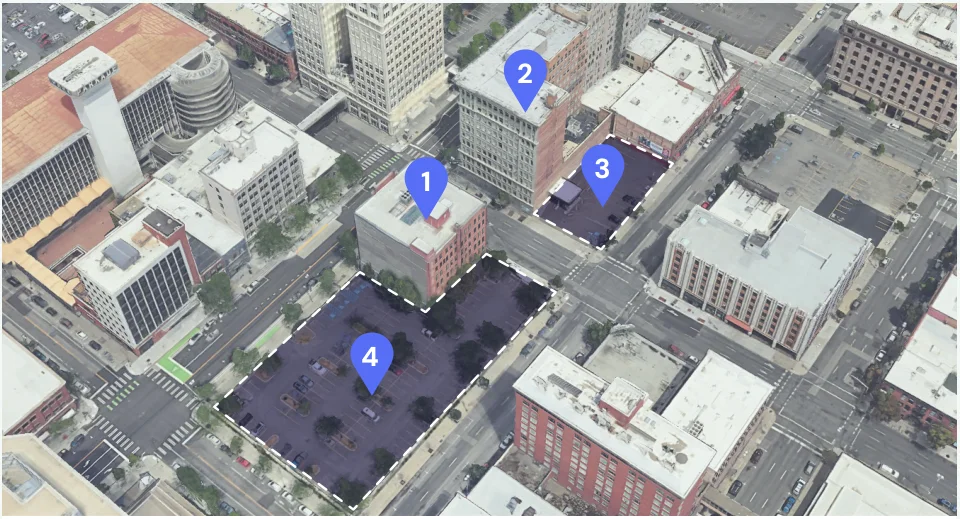
1. Office Building
Tax Bill: $43,000
(~$4.71/Sq Ft)
2. Office Building
Tax Bill: $77,000
(~$2.69/Sq Ft)
3. Parking Lot
Tax Bill: $7,000
(~$0.61/Sq Ft)
4. Parking Lot
Tax Bill: $32,000
(~$0.71/Sq Ft)
Source: CLE analysis of Spokane parcel assessment and property tax data.
Downtown office buildings versus surface parking
In downtown Spokane, two office buildings on comparable land pay markedly different taxes from nearby surface parking lots. One office building carries a tax bill of approximately $43,000, or $4.71 per square foot of land. A nearby parking lot on similarly valuable land pays just $7,000, or $0.61 per square foot, meaning the office building pays roughly 7 times more per square foot simply because it has put the land to productive use. A second office building pays $77,000, or $2.69 per square foot, while a neighboring parking lot pays $32,000, or $0.71 per square foot, again nearly 4 times more for the building than for the lot next door.
These properties sit on the same block, benefit from the same infrastructure, and draw on the same economic demand. The only meaningful difference is that one owner built something and the other did not. The tax system punishes the one who built and rewards the one who kept their land idle.
Example 02
An empty lot near the convention center pays a fraction of what productive uses pay
A nearby hotel and multifamily condominium pay more than six times as much per square foot of land as a vacant parcel benefiting from the same downtown location.
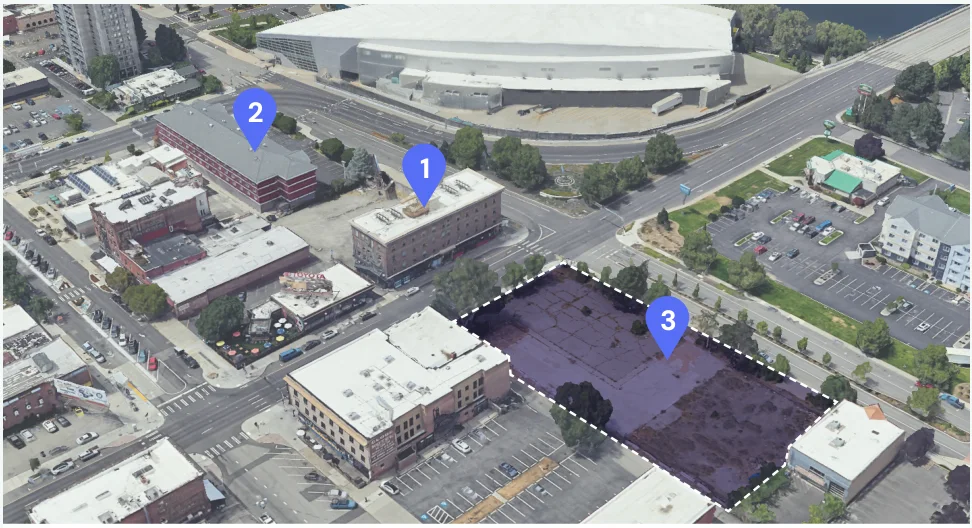
1. Multifamily Condo
Tax Bill: $12,000
(~$1.68/Sq Ft)
2. Hotel
Tax Bill: $63,000
(~$1.76/Sq Ft)
3. Vacant Lot
Tax Bill: $11,000
(~$0.26/Sq Ft)
Source: CLE analysis of Spokane parcel assessment and property tax data.
Vacant land versus active commercial use
A vacant parcel sitting directly across the street from Spokane’s convention center pays roughly $11,000 in annual property taxes, or $0.26 per square foot. A neighboring multifamily condominium pays $12,000, or $1.68 per square foot, more than 6 times the rate of the vacant lot despite sitting on land of comparable value. A nearby hotel pays $63,000, or $1.76 per square foot, nearly 7 times what the vacant lot pays per square foot.
Put another way: the hotel generates tax revenue, employs people, and serves visitors, yet pays almost seven times more per square foot than the empty lot across the street. The vacant lot’s owner, meanwhile, benefits from the same convention center foot traffic and downtown demand that makes the hotel viable, and pays a fraction of the cost for that privilege.
Example 03
Residential infill is taxed much more heavily than vacancy
A vacant residential lot pays about $0.07 per square foot in annual property taxes, while nearby three-unit homes pay roughly $0.54 per square foot.
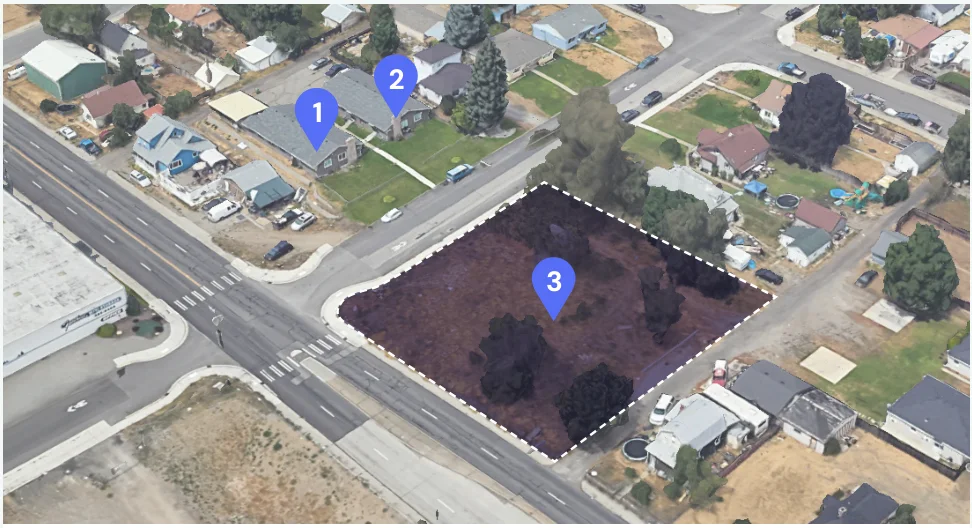
1. Three-Unit House
Tax Bill: $3,600
(~$0.54/Sq Ft)
2. Three-Unit House
Tax Bill: $3,600
(~$0.54/Sq Ft)
3. Vacant Lot
Tax Bill: $1,500
(~$0.07/Sq Ft)
Source: CLE analysis of Spokane parcel assessment and property tax data.
Residential infill versus vacancy
The same dynamic plays out in residential neighborhoods. A vacant residential lot in one Spokane neighborhood pays just $1,500 per year in property taxes, or $0.07 per square foot. Directly across the street, a three-unit residential building pays $3,600, or $0.54 per square foot, nearly 8 times more per square foot than the vacant lot next door. A second three-unit building nearby faces the same bill.
That gap is worth sitting with for a moment. Two property owners, on the same street, with land of similar value. One built three units of housing, contributing to the neighborhood, housing three families, and taking on all the costs and risks of development. The other owner left their lot empty. The tax system rewards the owner sitting on an empty lot with a bill 8 times lower per square foot than the neighbor who built housing for three families.
These examples are not outliers. They reflect a consistent pattern across Spokane and across Washington state in which the tax system quietly subsidizes inaction and taxes productivity.
Recognizing this constraint, the Spokane City Council voted 7–1 in 2025 to make land value taxation a state legislative priority. The most direct fix would be to simply charge a higher tax rate on land than on buildings, separating the two components of the property tax bill and reducing the penalty on investment. However, Washington’s constitution requires that property be taxed uniformly, meaning the state cannot apply different rates to land and buildings directly.
Instead, to shift taxes from buildings to land, Spokane is pursuing a building exemption as a practical and constitutional path forward. A building exemption achieves the same outcome through a different mechanism: by reducing the taxable value of buildings, it effectively lowers the tax burden on improvements relative to land without applying different rates to each. State legislation would be required to give Washington cities the authority to do the same.
How a building exemption would work
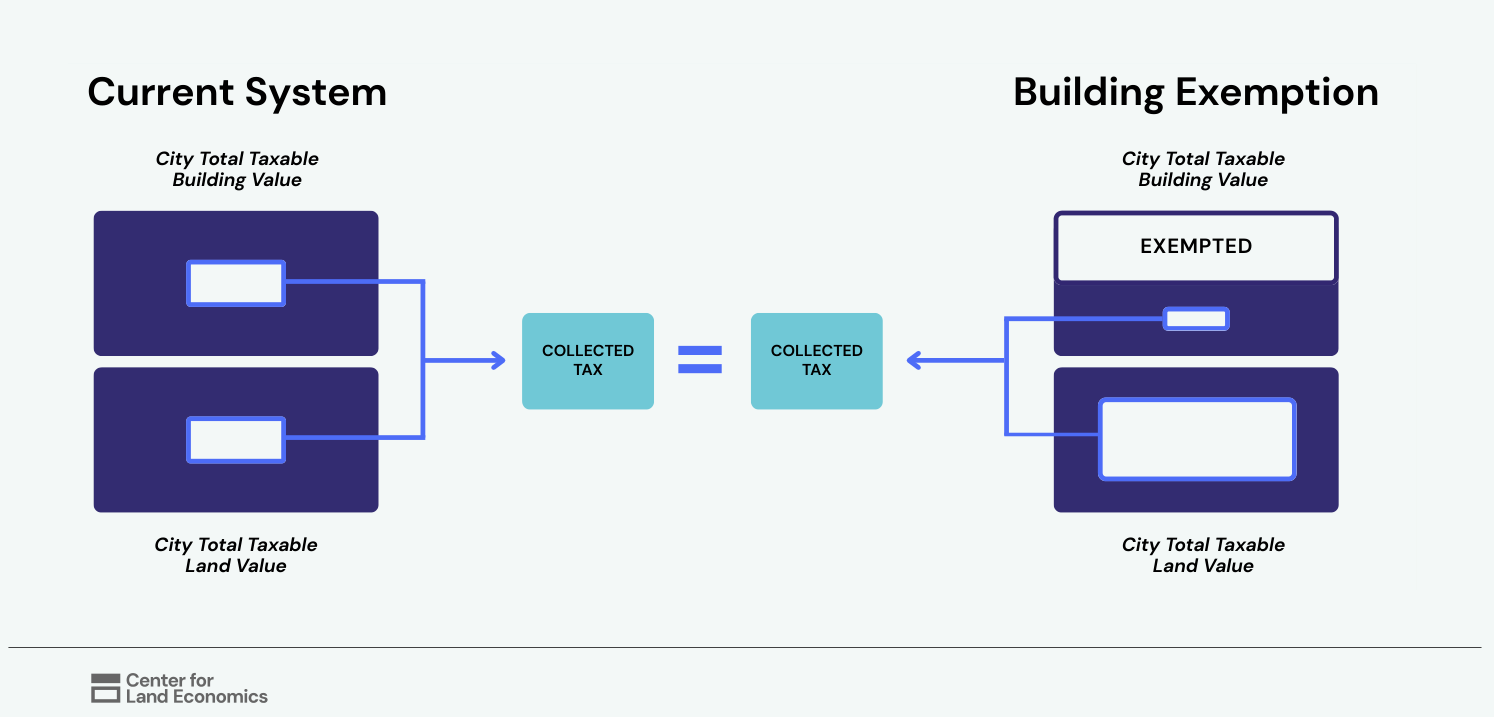
The mechanism is straightforward. By exempting a portion of building value from taxation citywide, the total taxable base shrinks. To collect the same total revenue, the city raises its overall property tax rate. That rate increase is mechanical, not discretionary: it is calculated to produce exactly the same revenue as before, just distributed differently. Owners of vacant lots and underused land pay more because their tax bill is driven almost entirely by land value, which is unaffected by the exemption. Owners of homes and productive buildings pay less because the exemption reduces the taxable share of what they have built. The city collects the same amount either way.
The approach would give cities several policy levers to design their exemption. A city could apply a flat base exemption that excludes a fixed dollar amount of building value on every property, a percentage exemption that reduces the taxable share of building value across the board, or a combination of the two. Cities could also choose which local levies the exemption applies to, allowing the policy to be tailored to local conditions and legal constraints.
A building exemption shifts taxes off improvements and onto land without raising revenue
By exempting a portion of building value and recalculating rates to maintain revenue neutrality, the tax base shifts toward land while total collections remain unchanged.
What the law allows — and what it limits
The building exemption approach draws on the Washington state legislature’s established authority to create property tax exemptions for policy purposes. Washington’s tax code already contains numerous such exemptions — for multifamily housing development, historic property rehabilitation, nonprofit organizations, senior and disabled homeowners, and home improvements, among others. The building exemption proposed under the approach follows in this tradition, using the legislature’s exemption authority as its legal foundation rather than attempting to create a new taxing structure from scratch.
Within that framework, existing legal limits on property taxation remain fully in effect. Washington’s constitution caps total regular property taxes on any property at 1 percent of assessed value, or $10 per $1,000 of value, when all taxing districts are combined (Washington Constitution, Article VII, Section 2). State law separately caps the aggregate rate for non-voted local levies at $5.90 per $1,000 of assessed value and limits a city’s own regular levy to $3.60 per $1,000 (RCW 84.52.043). These rate caps set a practical upper bound on how large a building exemption a city can implement: exempt too much building value and the rate adjustment required to maintain revenue neutrality would push the levy rate above the legal ceiling.
Within those bounds, cities retain meaningful flexibility. Voted levies and other levies not subject to the same statutory caps can be treated differently, giving municipalities room to calibrate their exemption while remaining in full compliance with state law.
This approach could also unlock an additional layer of flexibility for cities looking to go further. Because voted levies are not subject to the same statutory rate caps as regular levies, cities can bring measures directly to voters that apply a full 100 percent building exemption to those levies, effectively making them pure land value taxes. This means Spokane and other cities that opt in gain not just the ability to shift existing levies toward land, but the ability to design future voter-approved levies as land-only taxes from the ground up, a more complete realization of the land value taxation principle than the building exemption alone can achieve under existing levy constraints.
Who would adopt it
This approach would require authorization from the state legislature to allow taxing jurisdictions to opt in. In practice, the most likely jurisdictions to adopt are those closest to the problem: cities and, in some cases, school districts, which together account for a meaningful share of the total property tax bill. Counties and the state itself are less likely to adopt such an approach, at least initially, and its effectiveness does not depend on their participation.
This is not a limitation of the policy so much as a reflection of how tax reform tends to work. Cities feel the consequences of vacant land and underinvestment most directly, and are therefore the most natural first movers. A city-level adoption of a building exemption, even without county or state participation, could still shift incentives in the ways that matter most for land use and housing production.
Modeling the tax shift in Spokane
To understand how a building exemption would operate in practice, the Center for Land Economics modeled a specific policy configuration reflecting both the legal constraints facing Spokane and the flexibility of a building exemption approach. The model covers city and school district levies, the two jurisdictions most likely to adopt the exemption. County and state levies are not included in the model, consistent with the expectation that those jurisdictions would not opt in. The results are therefore a conservative estimate of the policy's full potential impact: a broader adoption across more levies would produce larger shifts in the same direction.
How the exemption was modeled
We modeled the building exemption as it would realistically be implemented by two jurisdictions: the City of Spokane and Spokane School District 081 (SD081). Each jurisdiction applies the exemption independently through its own levies, reflecting how the approach would operate in practice, with local taxing jurisdictions opting in and implementing separately.
The exemption is structured in two tiers depending on the levy. For SD081 levies (SD081 Spokane B&I and SD081 Spokane General) and certain City of Spokane levies (Spokane Bond, Spokane Bond New, Spokane Park, and Spokane EMS), we applied a higher exemption: a $100,000 base exemption is applied first, followed by a 75 percent improvement value exemption. For the remaining city levies subject to the regular levy rate limit of $3.60 per $1,000 of assessed value (RCW 84.52.043) — specifically Spokane General — we applied a lower base exemption of $40,000 and 20 percent general exemption of improvement value, which raises the effective tax rate to approximately $3.45 per $1,000, safely below the statutory cap. Any levy outside these two groups is carried through unchanged; those tax burdens remain the same under the modeled policy.
The table below summarizes the levies included in the model, along with their current rates and the adjusted rates required to maintain revenue neutrality under the building exemption. While statutory rate limits require higher millage rates under the exemption, the reduction in taxable building value results in a lower effective tax burden on improvements overall.
| Levy name | Exemption structure | Current rate (mills) | New rate (mills) |
|---|---|---|---|
| SD081 Spokane B&I | 75% exemption + $100k floor | 1.36 | 3.53 |
| SD081 Spokane General | 75% exemption + $100k floor | 2.5 | 6.46 |
| Spokane Bond | 75% exemption + $100k floor | 0.09 | 0.24 |
| Spokane Bond New | 75% exemption + $100k floor | 0.22 | 0.59 |
| Spokane EMS | 75% exemption + $100k floor | 0.5 | 1.30 |
| Spokane Park | 75% exemption + $100k floor | 0.27 | 0.75 |
| Spokane General | 20% exemption + $40k floor | 2.51 | 2.85 |
Agricultural properties are held steady under the modeled policy, meaning their tax bills on affected levies remain unchanged. This reflects a policy option available under this approach to protect farmland from tax increases, and is a minor consideration given that agriculture represents a very small share of land use within Spokane city limits.
The rate-solving for SD081 levies is conducted across all properties that pay SD081 levies, which extends beyond Spokane’s city boundaries. Similarly, city levy rates are solved across all Spokane levy-paying properties. However, results are reported only for properties within Spokane city limits. This allows for a clean demonstration of the policy’s aggregate effect on the city itself, the jurisdiction most likely to drive adoption and the community whose incentives the policy is most directly intended to change.
The modeling process, in four steps
- 1We recreated the current property tax system within Spokane by calculating the tax collected from every property for every applicable city and school district levy, accounting for all existing exemptions.
- 2We applied the assumed building exemptions to reduce the taxable building value for each property under each levy.
- 3For every levy, we calculated the new rate required to collect the same total revenue from the relevant levy-paying properties given the smaller taxable base, assuming the building exemption stacks with all current exemptions without pushing any property into negative taxable value.
- 4We calculated new tax bills property by property under the adjusted rates and summed across all applicable levies. This allows for a direct comparison between each property's current tax bill and its modeled bill under the exemption.
One important note on scope: this model captures only the immediate, first-year tax shift. It does not attempt to model behavioral responses, changes in development patterns, or the longer-term effects on land values and the tax base. Those effects are real and meaningful, but they are not reflected here. This means the model likely undersells the full impact of the policy in two important ways.
Benefit to renters and homebuyers
Over 40 percent of Spokane residents are renters, and this model only captures the changes in tax bills of property owners. Renters do not receive a property tax bill directly, but feel the effects indirectly: landlords factor taxes on improvements into the rents they charge. By reducing the tax burden on apartment buildings, the policy lowers one of the baseline costs of providing rental housing, which over time should reduce upward pressure on rents. Meanwhile, evidence shows that taxes on land are not passed on to renters (Høj, Jørgensen & Schou 2018).
For prospective homebuyers, the same principle applies: lower taxes on improvements reduce the ongoing cost of owning a home, and because taxes on land are not capitalized into purchase prices in the same way, shifting the burden toward land may over time moderate what buyers need to pay to get into the market. Lowering taxes on improvements and shifting them to land is thus maximally beneficial for renters and homebuyers.
Increased housing supply
More importantly, raising the cost of holding land vacant or underused, while lowering taxes on building, encourages more housing to be built, increasing the supply of homes available to rent. For renters, the long-term benefit of more housing supply is likely larger than any direct tax effect captured in this model.
Further, by raising the cost of holding well-located land vacant, the policy specifically redirects development pressure toward the urban core. Land that might otherwise have been skipped over in favor of cheaper peripheral sites becomes more costly to sit on and more attractive to develop. As that inward shift occurs, the outward pressure on land values further from downtown eases, which over time reduces tax burdens on single family homeowners in those neighborhoods. For these reasons, the immediate tax shift modeled here is the floor, not the ceiling.
Implications for development
Property taxes on improvements function as an ongoing cost of development, similar to operating expenses. Over time, these taxes are capitalized into project feasibility, affecting both investment decisions and the cost of delivering new housing.
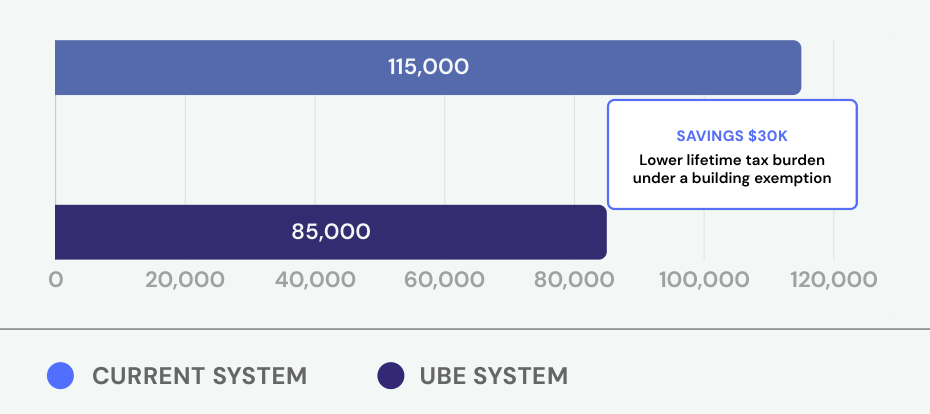
Under the current system, a new $1 million building in Spokane faces an effective tax rate of approximately 0.75 percent on improvements from just the modeled levies. Under the building exemption, that effective rate falls to approximately 0.55 percent.
Over a 30-year period, this reduction produces a meaningful difference in the present value of tax liability. At a 5 percent discount rate, the total tax burden on a $1 million building falls from approximately $115,000 under the current system to approximately $85,000 under the building exemption, a reduction of roughly $30,000.
Put differently, the current tax system increases the effective cost of new development by approximately 3 percent of project value relative to a land-focused tax structure. The building exemption removes much of this penalty, improving project feasibility and reducing the cost of delivering new housing.
Cost of property taxes on a $1M building for the modeled levies
30-year present value, Spokane illustrative example
Results
Who pays more, who pays less
The modeling results show a clear and consistent shift away from unproductive land uses and toward productive ones.
The percentage changes shown in this section are calculated only for the city and school district levies modeled under the building exemption policy, not for a property’s full property tax bill. County, state, and other non-participating levies are carried through unchanged and are not included in these percentage-change figures. As a result, the changes shown here describe the impact within the affected policy levies; the percentage change on a taxpayer’s total property tax bill would be smaller because only part of the full levy stack is changing.
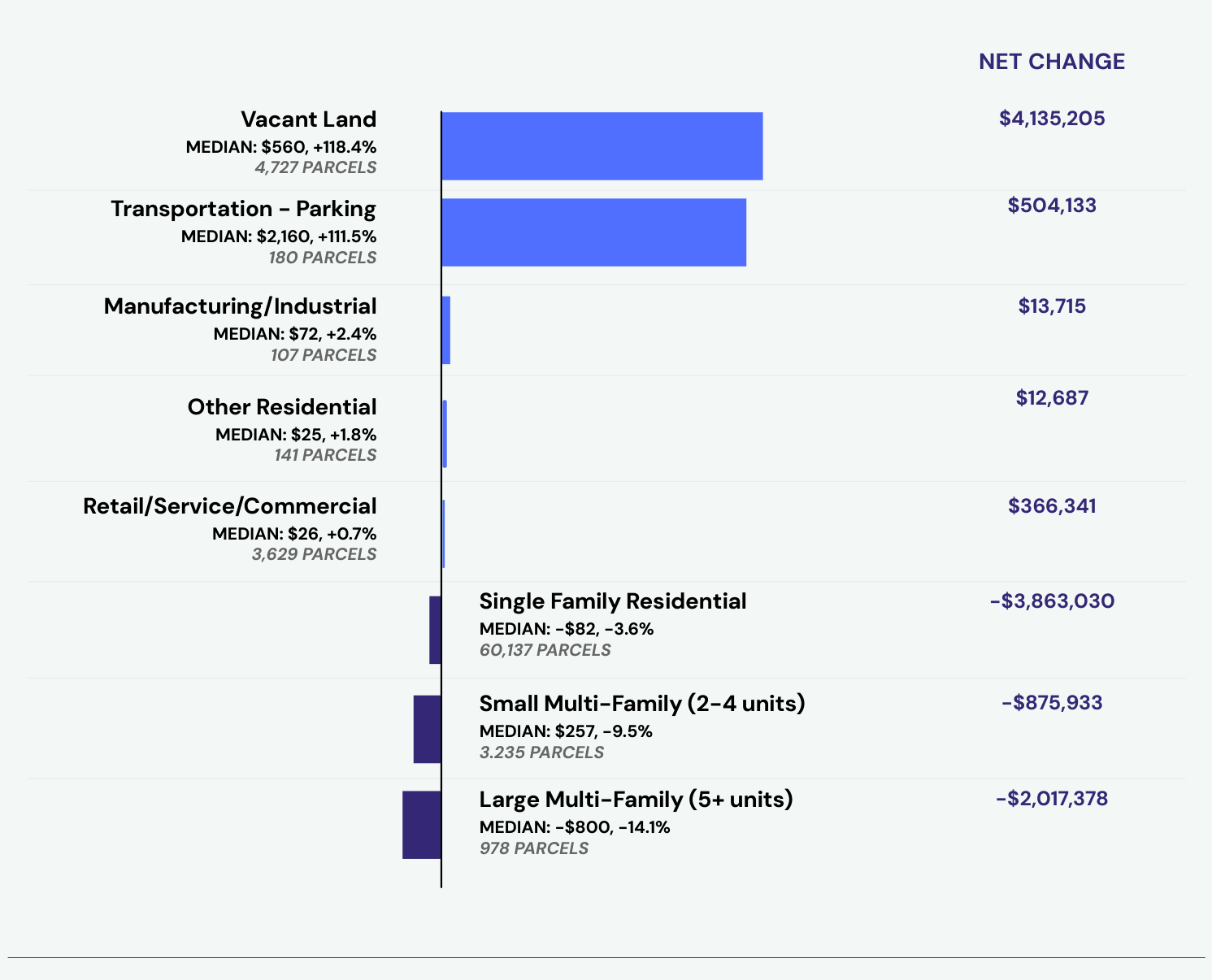
Vacant land and surface parking see the largest increases, with median tax increases of 118.4 percent for vacant land and 111.5 percent for parking properties. The policy makes it more expensive to sit on valuable urban land while the surrounding community’s investments push that land’s value higher.
Commercial and industrial properties see very modest changes. Retail, service, and commercial properties see a median increase of just 0.7 percent, and manufacturing and industrial properties see a median increase of 2.4 percent. For these property types, the policy is effectively neutral, a meaningful reassurance that the reform is targeted at idle land rather than active business uses.
Within the modeled levies, residential properties see meaningful decreases on average. Single-family homes experience a median decrease of 3.6 percent. The benefits are larger for rental housing: small multifamily buildings of two to four units see a median decrease of 9.5 percent, and larger multifamily buildings of five or more units see a median decrease of 14.1 percent.
That last figure is substantial; large apartment buildings, which house a significant share of Spokane’s renters, see their tax burden fall by more than one in seven dollars under the modeled policy. While property tax bills are sent to owners, taxes on buildings are often passed through to tenants in the form of higher rents. By meaningfully reducing the tax burden on apartment buildings, the policy removes a significant financial penalty on the housing that renters depend on.
Vacant land and surface parking pay more, while housing pays less
In modeling a building exemption shifting tax burden from buildings to land, vacant land and parking properties see the largest median increases, while single-family and multifamily residential properties see median decreases.
Source: CLE analysis of Spokane parcel assessment and levy data.
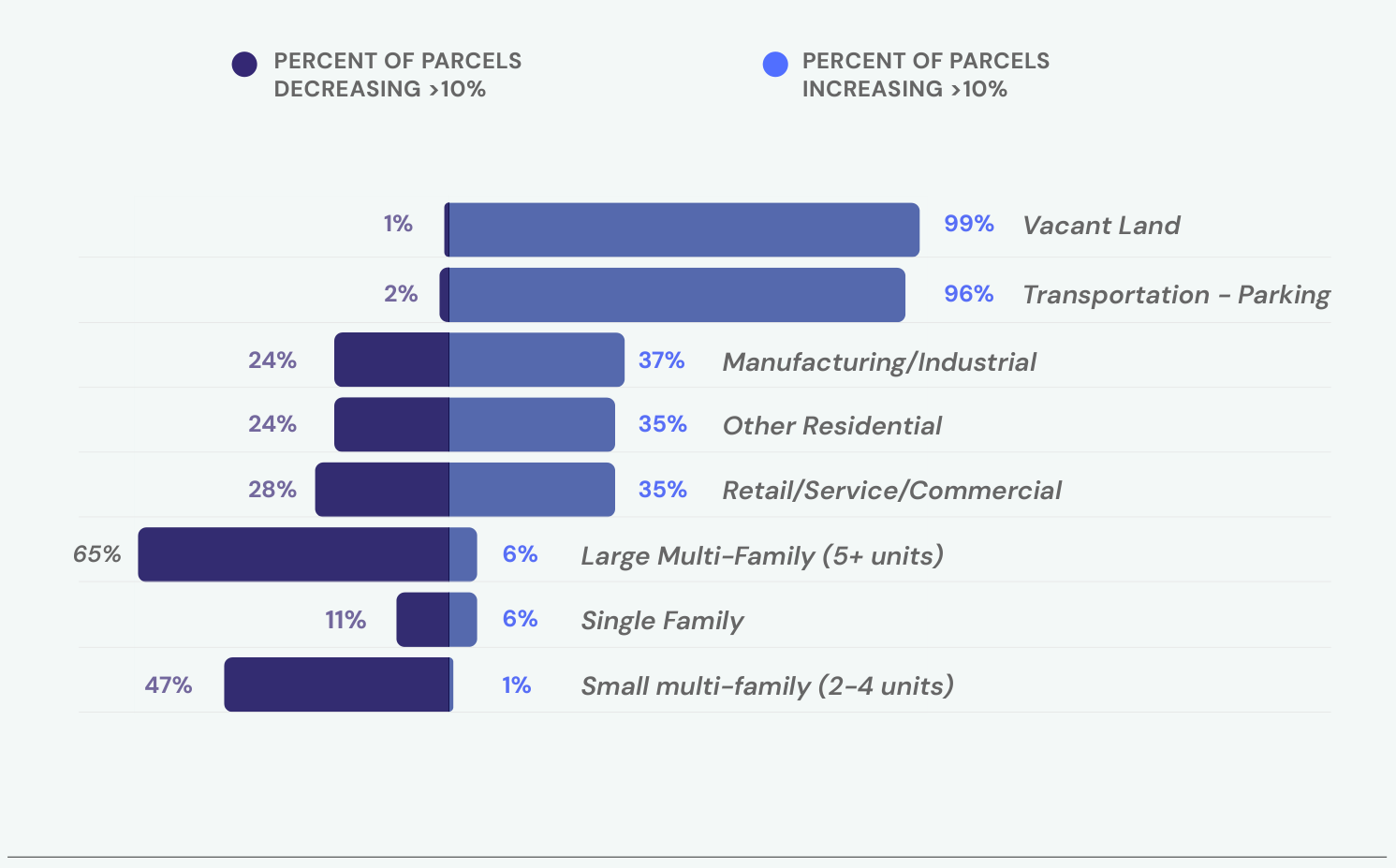
Looking beyond medians, the share of properties experiencing large changes tells a similar story. Nearly all vacant land and parking properties see tax increases greater than 10 percent, at 99 percent and 96 percent respectively, the intended effect of the policy. Among single-family homes, the distribution remains narrow: only 6 percent see increases greater than 10 percent, while 11 percent see decreases greater than 10 percent. The story is more pronounced for multifamily housing. Among large multifamily buildings of five or more units, 65 percent see decreases greater than 10 percent, while only 6 percent see increases of that magnitude. For small multifamily buildings of two to four units, 47 percent see decreases greater than 10 percent, while just 1 percent see increases above that threshold. Across both multifamily categories, meaningful tax reductions are the rule rather than the exception, reinforcing the policy’s strong support for the housing that renters depend on most.
Large tax increases are concentrated on vacant land and surface parking
In modeling a building exemption shifting tax burden from buildings to land, vacant land and parking parcels see increases above 10% within the modeled policy levies, while large decreases are concentrated among multifamily housing.
Source: CLE analysis of Spokane parcel assessment and levy data.
Equity
Equity and distributional outcomes
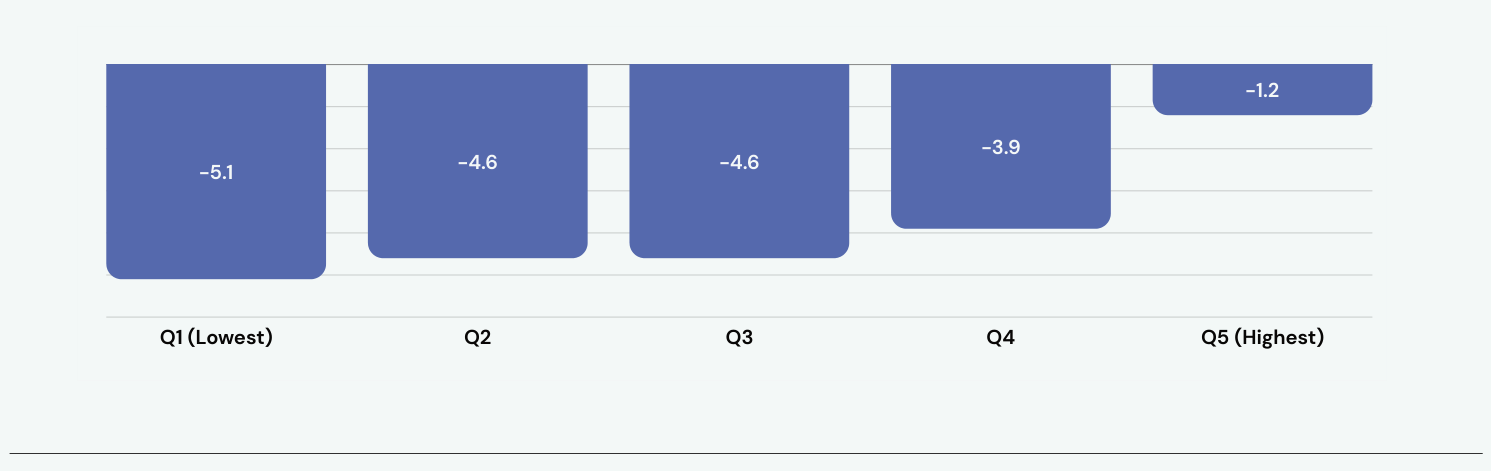
The tax shift is not just efficient but also progressive. We examined median tax changes by neighborhood income, dividing Spokane’s census block groups into five equal quintiles from lowest income to highest. Restricting the analysis to residential, non-vacant properties to focus on actual household impacts rather than land speculation, the results show a clear gradient.
Lower-income neighborhoods see the largest residential tax reductions
Among residential, non-vacant parcels, median tax reductions are largest in the lowest-income census block groups and smaller in higher-income areas.
Source: CLE analysis of Spokane parcel assessment and levy data, joined to census block group income data.
The lowest-income neighborhoods see the largest median tax decreases, at 5.1 percent, while the highest-income neighborhoods see much smaller reductions, at 1.2 percent. The middle quintiles cluster closely together, with Q2 and Q3 each seeing median decreases of 4.6 percent and Q4 seeing a decrease of 3.9 percent. Lower-income households, who are more likely to own modest homes on land with relatively high improvement-to-land value ratios, benefit more from the building exemption than higher-income households whose properties often include more land value.
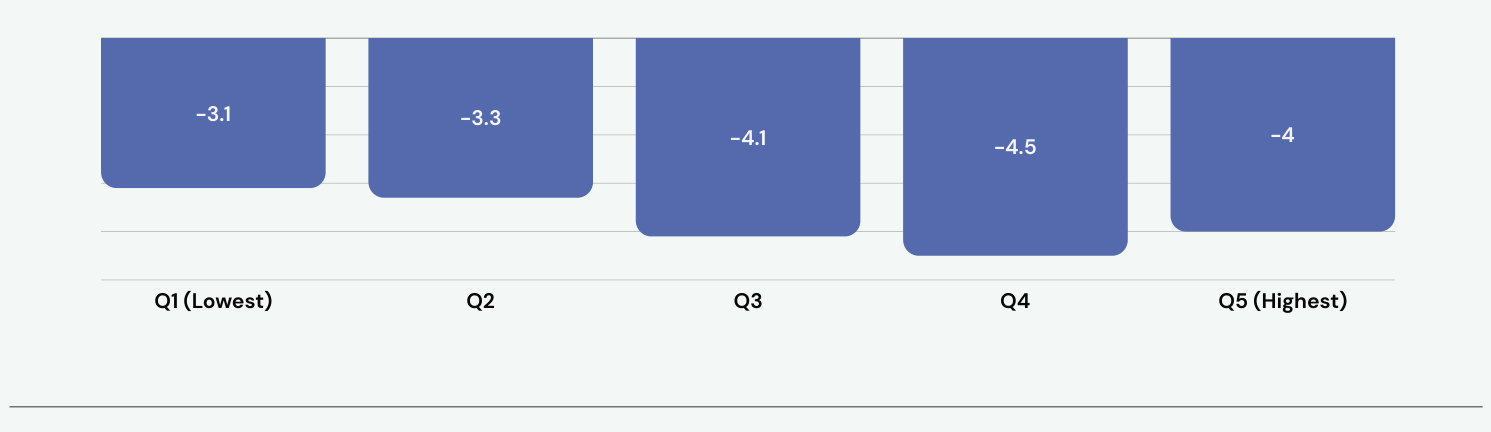
We conducted the same analysis using neighborhood racial composition, dividing census block groups into quintiles from lowest to highest share of minority residents. The results follow a similar pattern, though the gradient here is somewhat more gradual.
More diverse neighborhoods see larger residential tax reductions
Among residential, non-vacant parcels, median tax reductions generally grow as the neighborhood minority population share increases.
Source: CLE analysis of Spokane parcel assessment data and Google Earth.
Neighborhoods with the lowest minority populations see a median tax decrease of 3.0 percent, while the most diverse neighborhoods see decreases of 4.6 percent in Q4 and 4.1 percent in Q5. The progression is consistent across all five quintiles, with reductions growing as minority population share increases. This suggests that the modeled exemption shifts taxes in a way that aligns with broader equity goals, reducing burdens most in the communities that have historically faced the greatest barriers to building wealth through homeownership.
Taken together, the Center for Land Economics’ modeling of Spokane demonstrates that a building exemption applied across all parcels can meaningfully change incentives without destabilizing the tax system. The policy turns up the heat on speculation while reducing penalties on housing and productive development, leaves most single-family homeowners largely unaffected, and produces progressive outcomes across both income and race. The modeling suggests that Spokane can rebalance its property tax system in a way that supports infill development while maintaining revenue stability and legal compliance.
A proven policy
Spokane would not be the first U.S. city to test this approach. Pennsylvania has allowed municipalities to tax land at a higher rate than buildings — a policy known as split-rate taxation that achieves the same practical outcome as a building exemption through a different legal mechanism — for decades, and researchers have studied the impacts in cities like Pittsburgh and Harrisburg. Because these reforms were typically revenue-neutral shifts, they offer a close real-world comparison to Spokane's proposed building exemption.
Housing production and infill development increased under these systems. In Pittsburgh, a shift toward land-focused taxation is estimated to have produced about a 13 percent increase in housing units under construction, with the increase concentrated in the city rather than suburbs. Broader municipal studies across Pennsylvania find similar results: jurisdictions that taxed land more heavily tended to see higher development intensity, measured as more housing capacity per unit of land, consistent with the theory that land-focused taxation discourages speculation and encourages infill (Bourassa 1989, 1990; Banzhaf & Lavery 2010).
Beyond housing, the evidence points to broader economic benefits as well. One study finds an immediate 12 percent increase in the number of business establishments following adoption of land-focused taxation, especially in space-intensive industries like retail, wholesale, transportation, manufacturing, and construction (Hanson 2022). Research on market impacts also finds that revenue-neutral shifts toward land taxation are associated with increases in aggregate property values over time, driven largely by stronger structure values that offset any reduction in land prices (Yang 2018; Yang & Hawley 2022). Together, these results offer strong real-world evidence that shifting taxes from buildings onto land can increase housing production and economic activity without undermining overall property values.
Conclusion
Spokane’s development challenges are not due to a lack of demand, nor can they be solved by land use reform alone. The city has already expanded housing capacity and modernized its zoning, yet valuable land remains vacant or underused in the exact places where housing and economic activity are needed most. The property tax system is not the sole cause of this, but it is a significant and largely overlooked one, and it is one that cities can actually change, with state authorization.
A building exemption approach, enabled through state legislation, could give Spokane and other Washington cities the power to do exactly that, shifting the tax burden off buildings and onto land in a way that is revenue-neutral, legally grounded, and supported by evidence from Pennsylvania. The modeling presented here shows that Spokane can implement this shift in a way that reduces taxes on homeowners and renters, concentrates higher costs on vacant and underused land, and produces progressive outcomes across income and race.
Spokane has already done the hard work of building the legal and political foundation for this reform. Enabling a building exemption would be a natural next step, providing a powerful and flexible tool to ensure that the city’s tax structure works with its broader goals rather than against them.
Read or share the full report
The complete report, with all figures and methodology, is available as a PDF download.
Support our research
The Center for Land Economics is a 501(c)(3) nonprofit. Research like this is supported by donors like you. Donations help fund the next report.
Donate